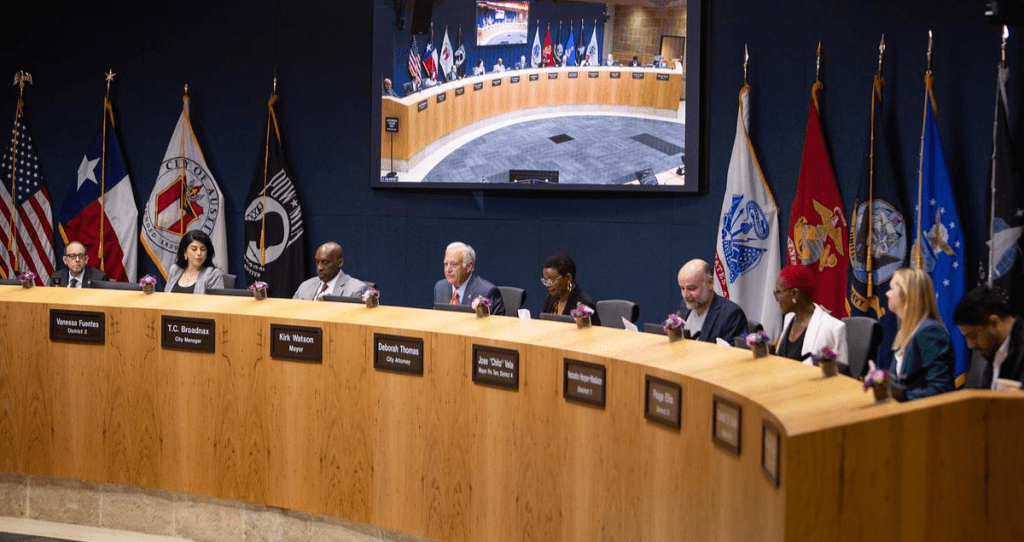
Austin voters will decide this November whether to approve $295 million in borrowing for parks and libraries after the Austin City Council voted Thursday to place the measures on the ballot, capping two years of debate over whether the city could afford another bond amid broader concerns about taxes and city spending.
The package includes two propositions — a $260 million bond to fund park improvements, pools and land acquisition, and a $35 million bond for libraries. While the Austin City Council on Thursday unanimously voted to place the two propositions on the ballot, the decision followed a split vote Tuesday, when the mayor and two council members opposed calling the election. They argued the city should not ask voters to approve another tax-supported bond package while the majority of the funding from previously approved bonds remains unspent.
While the mayor and two other council members sided with city financial staff, a majority on the dais asserted the need for funding was too great to delay and noted the Parks and Recreation Department has already committed the vast majority of the funding approved by voters in the 2018 bond.
“I think this proposal is laser-focused on some of the greatest areas of need for our capital program – to fund parks improvements, which is essential for a city of our size that has grown so much in recent years and hasn’t seen a parks bond program since 2018,” Council Member Mike Siegel said ahead of Tuesday’s vote. “This bond proposal is small enough that it doesn’t require a major burden on taxpayers.”
City financial staff recommended in the spring the City Council delay a bond election until 2028, when previous bond programs would be considered completed, defined as spending about 90% of bond funds.
“Good government is disciplined government, not rigid, not ideological, but disciplined. It follows the process it creates. It doesn’t change the rules because they’re inconvenient. It earns trust by demonstrating that its principles actually govern its decisions,” Mayor Kirk Watson said on Tuesday before voting against the election. “We shouldn’t weaken the trust we’ve worked so hard to rebuild.”
If voters approve both propositions this fall, the owner of a median-valued home of about $485,000 would pay roughly $40 more in annual property taxes, though the actual impact would be less if the funding is spent over the next several years. That would increase the annual city property tax bill on a median-valued home from about $2,071 to $2,111, assuming property tax rates otherwise remain unchanged.
Propositions A and B
Austin City Council voted to call a bond election and finalized language for two propositions: a $260 million parks bond and a $35 million library bond.
Proposition A includes:
- $65.5 million for park buildings and facilities, including those for Gus Garcia Recreation Center, Doris Miller Auditorium and Mayfield Park $65 million for parkland improvements at Jamestown Neighborhood Park, Bolm District Park, Walter E. Long Metro Park, Lantana Neighborhood Park, Community Gardens, Old Lampasas Pocket Park, Cooper Neighborhood Park, Wooldridge Square, Onion Creek Metro Park, Guitar Land, Grand Meadow and Commons Ford Park.
- $29.5 million to improve park infrastructure at Williamson Creek Trail, Evergreen Cemetery, Onion Creek All Abilities Playground, Brentwood Neighborhood Park, Riata Neighborhood Park, Springwoods Park, St. Edward’s Greenbelt, Zilker Metro Park, Commons Ford, Circle C Metro Park, Mount Bonnell and improvements to electric infrastructure citywide.
- $65 million for Garrison Municipal Pool, Big Stacy Neighborhood Pool, Walnut Creek Municipal Pool and Civitan Neighborhood Pool.
- $35 million for infill parks in park-deficient areas, greenbelts and greenways to increase trail connectivity and parkland acquisition, including land for a new southeast recreation center.
Proposition B would fund:
- A $20 million renovation and expansion at Hampton Branch at Oak Hill Library.
- $15 million for a new library at Colony Park.
Charter Amendments
The Austin City Council approved on Thursday eight charter amendments for the Nov. 3 ballot. Some of the amendments would clear up outdated or erroneous language in the charter. Two amendments would make substantive changes by requiring an efficiency audit of all city departments every five years and mandating citizen-led elections initiated through petition be held only during November elections in even-numbered years.
Supporters of the latter amendment contend the change will take advantage of higher voter turnout, while opponents argue waiting until even-numbered years could delay initiatives from reaching voters.
“I do not see any reason why we need to be telling the citizens of the city, if you want to use this referendum process, you can only have your election at a certain time,” David Weinberg, a candidate for the Austin City Council’s District 5 seat, said during city council’s July 28 meeting.
Council also affirmed elections will take place for City Council seats in Districts 1, 3, 5, 8 and 9. The filing deadline to run for those offices is August 17.