Last year’s city budget forced some Austin nonprofits to eliminate programs, restructure staff and scale back services. Now, as some are still recovering, they’re bracing for another round of cuts leaders warn could shrink Austin’s social safety net even further.
That’s the case for Christina Fernandez Collazo, Todos Juntos Learning Center’s executive director. After the fiscal 2026 reductions forced her organization to eliminate a program and reorganize staff, the city’s proposed budget would require even deeper cuts to her nonprofit.
The reductions “would impact the number of people we employ. It would impact health benefits,” said Collazo, whose organization offers education and workforce development opportunities for non-English speakers. “It would impact the number of people that we can serve.”
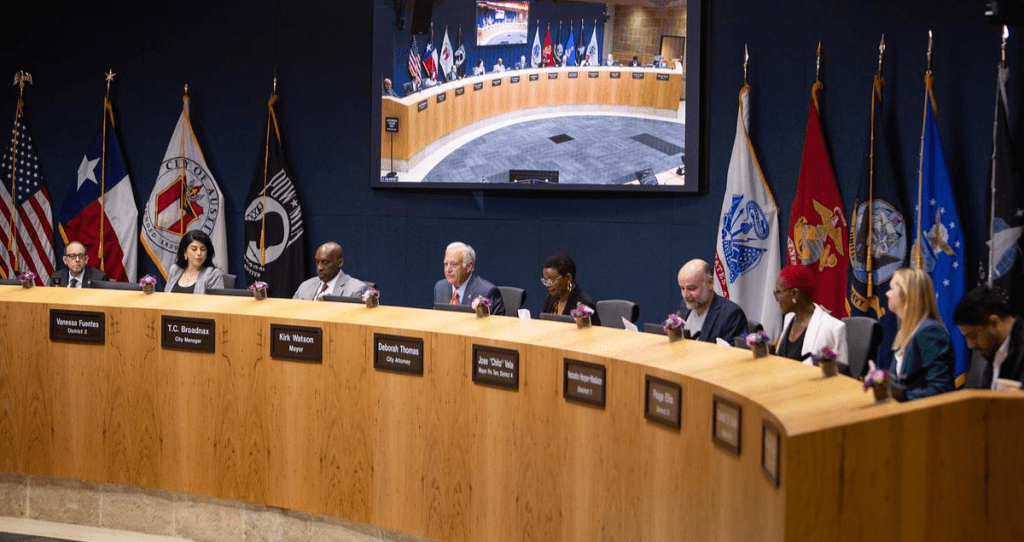
The growing concern over Austin’s safety net came to City Hall last Thursday, when nonprofit leaders, employees and clients packed council chambers to urge Austin City Council to reject more than $5 million in proposed cuts to social service contracts. They argued another round of reductions would weaken programs that provide mental health care, food assistance, early childhood education and other services for some of Austin’s most vulnerable residents. By the end of the often tense meeting, five council members had publicly backed restoring all, if not most of the funding.
“Public safety does not start with a 911 call. It starts in the moments before: behavioral health care, crisis intervention, parenting support, food security, and housing,” Lesley Varghese said during the meeting in support of One Voice Central Texas, a coalition of nonprofits pushing against the proposed cuts. “This council has made strides in these areas, but it’s not enough, and now is not the time to backpedal.”
Opposition to the social service cuts has been building since city financial staff signaled late last year that reductions would be necessary to help balance a strained budget. Public testimony took on added urgency Thursday following the fatal police shooting of 17-year-old Anthoneil Williams II. Many speakers argued the organizations facing cuts provide mental health and crisis services designed to prevent similar tragedies.
“The testimony (Thursday) reinforced this idea that our community wants us to maintain as strong a social safety net as possible here in Austin,” Council Member Mike Siegel said. “None of us feel good about the idea that each year when there is a budget deficit, the first place city management apparently looks is reducing social service spending.”
Siegel, along with four other council members, signed on to a message board post by Council Member Vanessa Fuentes supporting the use of an additional $4.7 million in newly-available property tax revenue to restore funding for social service programs. Siegel said he and his team are looking for ways to make up the remaining roughly $600,000 needed to fully reverse the cuts.
“For the programmatic areas — food, housing, mental health, and so on,” Siegel said, “we want to put the money back.”
On Monday, Austin Mayor Kirk Watson echoed concern that the cuts would reduce services for vulnerable Austinites. He suggested the city manager review each contract slated for reduction or elimination and return with recommendations on whether funding should be maintained, modified or reduced. If staff recommends changing a contract, Watson said the city manager should explain the reason, such as documented performance concerns.
“We should recognize that if we’re reducing a contract for whatever reason, that money may be well (maybe even better) spent elsewhere to serve children and families,” Watson said. “It may need to be redirected to create a stronger investment in children and families.”
Nonprofits brace for another round
Many social service nonprofits the city contracts with to deliver social services describe an increasingly-difficult funding environment that has developed in the years since the COVID-19 pandemic. Though private and public funding has declined, many organizations say demand for their services has continued to grow.
Collazo said she did not initially expect the defeat of Proposition Q in 2025 to affect her organization’s partnership with the city. Then came the 10% reduction in funding.
“We were a little blindsided,” said Collazo, whose organization provides early childhood education, workforce development and family support services to low-income families. “We actually had to sunset a program as a result of the cuts. We had to restructure and organize a little bit of our staffing plan.”
In February, the City Council approved an evaluation framework directing staff to first prioritize legally required services, then identify overlapping funding sources and opportunities for consolidation before evaluating contracts based on performance and equity considerations.
As staff developed the proposed budget, city financial staff initially planned roughly $17 million in reductions to social service contracts. The City Manager’s Office later scaled that back, recommending about $5.5 million in cuts for the 2027 budget and roughly $8 million in reductions the following year. The proposed reductions would reach across Austin’s social safety net. Of the more than 155 contracts the city has with nonprofit organizations, 53 would receive less funding under the proposed budget, while another 24 would be eliminated. The affected services include behavioral health, food access, job preparedness, domestic violence programs and early childhood education.
For nonprofit leaders, those figures represent more than a budget exercise. They translate into decisions about staffing, employee benefits and the number of people their organizations can serve.
Collazo argues investing in organizations like Todos Juntos ultimately saves taxpayers money.
“If we’re working with children and we’re getting them school-ready, that’s fewer remedial services that are needed once they begin school,” she said. “We just hope that the critical nature of the work that we do, especially around early childhood education and workforce development, would be (considered) vital to our economy.”
Rosamaria Murillo, CEO of El Buen Samaritano, said that as the former assistant director of Austin Public Health, she understands the difficult decisions city leaders face while balancing a budget constrained by property tax caps and slowing sales tax revenue.
“I understand that the city has to make budget decisions,” Murillo said. “I also think they are making these budget decisions on the backs of the most vulnerable communities.”