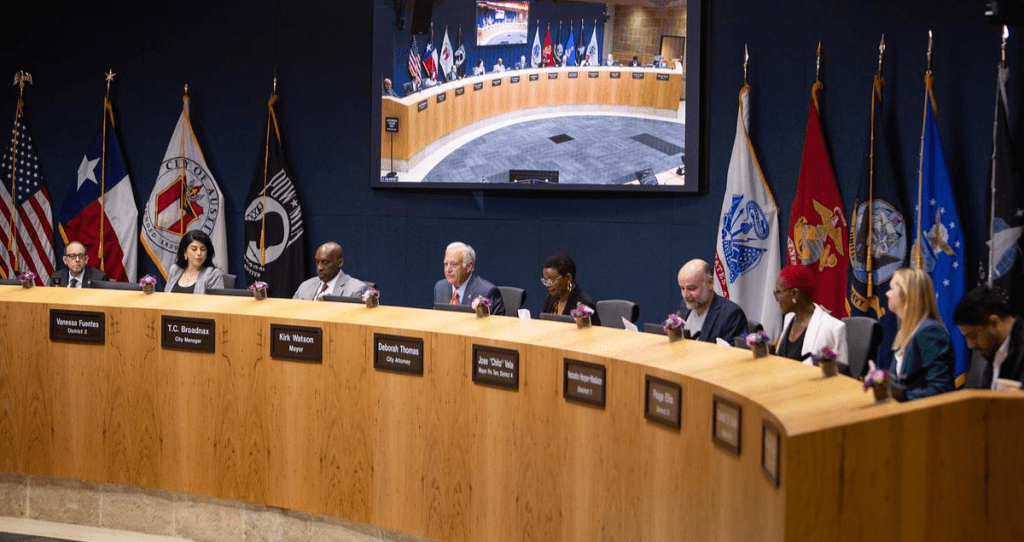
The Austin City Council finalized on Tuesday a bond proposal totalling $295 million that could go to voters this November, choosing to move forward with funding for Austin’s parks and libraries over recommendations from city financial staff to wait two more years. City Council will vote whether to place the proposals on the ballot this Thursday.
The council voted 8-3, with Mayor Kirk Watson and Council members Marc Duchen and José Velásquez opposing the measure.
The vote caps about two years of debate over whether Austin should ask voters to approve a tax increase to fund capital improvement projects after last fall’s defeat of Proposition Q. While city financial staff and Mayor Kirk Watson argued the city should wait until 2028, several council members on Tuesday said funding for deteriorating parks and libraries could not wait any longer, teeing up a final decision on Thursday.
“This bond proposal is small enough that it doesn’t require a major burden on taxpayers,” Council Member Mike Siegel said. “As to the affordability argument, city parks and recreational facilities offer some of the best opportunities for healthy activity at no cost or very low cost.”
City Council started planning for a 2026 bond election in 2024, forming a bond advisory task force. While staff at the time identified an estimated need for more than $4 billion, Austin’s Financial Services Department said in early 2026 that any bond election should be limited to $750 million because of the city’s financial outlook.
As debate continued, some City Council members backed a smaller option under $400 million focused largely on parks and community facilities, while others, including Watson, sided with city financial staff and pushed to delay a bond election altogether.
Those who opposed calling the election this year agree the city faces billions of dollars in capital needs. But they argued the decisive defeat of the city’s tax rate election less than a year ago showed voters weren’t ready to take on additional property taxes for infrastructure projects.
If voters approve the entire proposal this fall, it would cost the homeowner of an average-valued house of about $495,000 about $40 more in property tax annually, though the actual impact would be less if the funding is spent over the next several years.
What would the bond fund?
On Tuesday, the Austin City Council voted to approve $260 million in parks funding and $35 million for city libraries.
The $260 million in parks funding would go towards:
- $65.5 million for park buildings and facilities.
- $65 million for parkland improvements.
- $29.5 million to improve park infrastructure.
- $65 million for four Austin pools.
- $35 million for new parks and trails.
The $35 million in community facility funding would go towards:
- $20 million for Hampton Branch at Oak Hill Library renovation and expansion.
- $15 million for a new library and public health center at Colony Park.
Though City Council approved the size and shape of the bond proposal on Tuesday, a separate vote Thursday will secure its spot on the November ballot and finalize any ballot language.
Why council disagreed on timing
After voters rejected Proposition Q, Watson pushed forward several proposals aimed at improving public trust in how City Hall manages taxpayer dollars. Among them was a “decision tree,” designed to help the city determine whether calling a bond election in 2026 would be financially prudent.
Applying that framework, city financial staff determined previous bond programs had not yet reached what they consider program completion, defined as spending about 90% of bond funds. Based on that benchmark, they recommended waiting until 2028 to ask voters to approve another bond package. Watson agreed.
“We have spent months earning the public’s confidence. We shouldn’t abandon that process because it becomes inconvenient. We shouldn’t weaken the trust we’ve worked so hard to rebuild, and that is why I’ll vote no today,” Watson said before the Tuesday vote. “Not because I’m against parks, not because I’m against investment, but because I’m for disciplined government.”
Austin park advocates were quick to point out that the Parks Department had not received bond funding since 2018 and the entire $149 million dedicated then had already been allocated.
“There are the pools, parks, and green spaces that our communities love and depend on. And without real investment now, there are four pools at risk of becoming inoperable, and playgrounds that will go without the desperate need of repairs,” said Alyssa Vargas, advocacy manager at the Austin Parks Foundation, before Tuesday’s vote. “Our system faces $1.8 billion in unmet needs, and they grow every month that we delay.”
Council Member Marc Duchen, who voted against the bond Tuesday, expressed concern over the city’s recent inability to stick to a five- to six-year bond cycle, a standard in large cities across the country, according to city financial staff.
“What isn’t helpful is when we feel a pressure so intense that we start to have ad hoc bond elections every two years,” Duchen said. “I don’t think that’s going to stop unless we have an incredibly strong public commitment to make systemic changes for how we approach bonds, and that’s why I’d like to challenge ourselves and our staff to figure out how we can resolve that.”
What was left off?
Dozens of Austinites testified at City Hall on Tuesday morning in support of a bond election. Most urged the City Council to fund parks, community facilities and transportation improvement projects, although $92 million in dedicated transportation funding was ultimately left out of the proposed bond package.
“I think it would be a major step back to our mode shift, climate, and Vision Zero goals to not include funding for active transport projects this year,” Amy De Luna testified. “We need to continue investing in roadway safety improvements, sidewalks, bikeways, urban trails, safe routes to school, lanes, driving, riding a bike, riding a scooter, walking or taking the bus.”
Council Member Chito Vela said he would explore alternative financing tools to fund urgent transportation projects as the city contemplates a transportation bond package in the coming years.