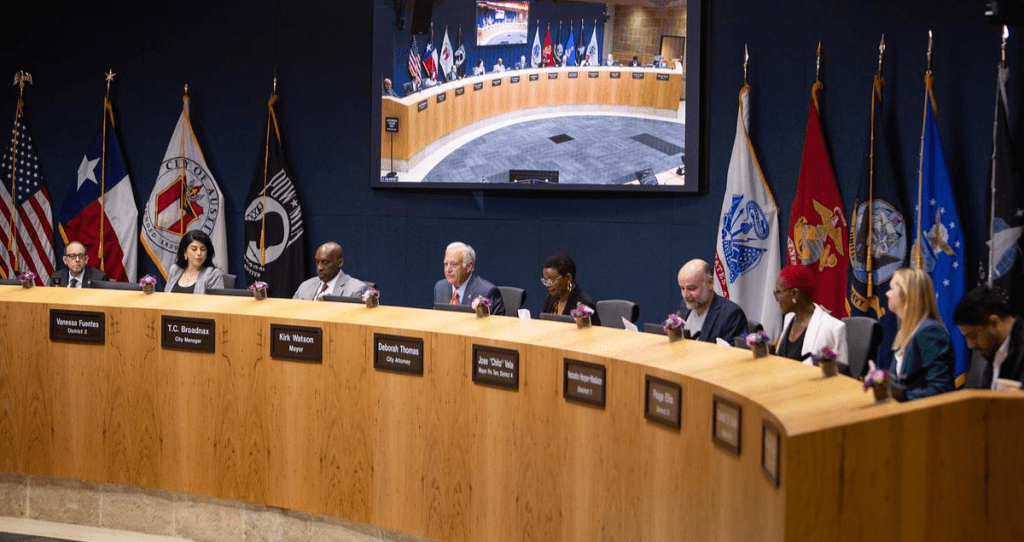
When dozens of people sounded off about Dog’s Head at a public meeting Wednesday night, speakers and developers agreed on little.
Developers say the project is planned on a bombed-out mining pit that is 95% outside of the floodplain. Environmentalists call it a beautiful slice of nature that is floodprone in its entirety.
For nearly four hours at the Austin Environmental Commission this week, dozens of speakers railed against Dog’s Head, a 2,600-acre proposed development in Southeast Austin. Endeavor, the developer, came to give the commission an overview of the project.
What played out over the course of the evening illustrated a yawning gap between what developers say and what some people believe.
Endeavor paints Dog’s Head as a reclamation process of an old mining site that will ultimately repair the land. Neighbors and environmentalists cast Dog’s Head as an irresponsible development that threatens the Colorado River. The disconnect between the two sides highlights what can happen when developers win political support before they win public trust.
After an unusually speedy initial development process, Endeavor is now reaching out to community members. Developers voluntarily appeared at the Environmental Commission. They also held a private meeting the night before with Dog’s Head neighbors. (Video and audio recordings of that meeting were provided to Austin Current.)
These are early days in a years-long development on four square miles located north of Austin-Bergstrom International Airport, along the Colorado River between U.S. 183 and Texas State Highway 130. Detailed information about future development remains scarce.
“This is kind of insane,” said Garrett Tung, who lives near the Dog’s Head site. “They want us to think there is no plan?”
Richard Suttle, Endeavor’s attorney, said at the Environmental Commission he expects a lot more discussion to come.
“This, in my mind” he said, “begins the earnest conversation about what can happen here.”
Dog’s Head details emerge
Three unusual things about Dog’s Head have helped spike tensions around the project.
The size: At 2,600 acres, the proposed mixed-use development will be almost nine times bigger than the 300-acre Domain, a mixed-used development in North Austin. It’s nearly four times larger than the 700-acre Mueller mixed-used community in Central East Austin.
The development agreement: When the City of Austin annexed the largely-flat, former mining site, it gave Endeavor something unusual: the ability to use the land for almost anything, including manufacturing, schools, restaurants, marinas and railroad, recycling and aviation facilities.
It also allowed the developer to bypass some public scrutiny by letting city staffers make some decisions that usually go before commissions.
The speed: In less than four months, the city put together a plan for four square miles of development. But because the city didn’t legally have to notify neighbors, most learned about the plans just days before City Council members were set to vote on May 21.
But, between the environmental commission and neighborhood meetings, Endeavor offered additional information to the public. According to the developer:
- Dog’s Head is competing with a city in another state to convince a Fortune 100 company to locate in Austin. That’s why the process needed to move fast.
- Endeavor will not rule out data centers on Dog’s Head. The Fortune 100 company the developer is courting is not a data center, but such industry could happen in the future.
- There are no plans to widen Hergotz Lane. Early maps appeared to draw lines through several people’s homes, but developers said they were not accurate.
- About 50-60% of the first Dog’s Head project will have impervious cover, meaning areas that water cannot permeate, like concrete. That’s far less than the 100 percent allowed in Endeavor’s development agreement with the city. More than 260 acres is slated for open space.
City leaders say they need a project like this to bolster city coffers being drained by caps on property taxes and the loss of federal relief funding. Dog’s Head could generate $3.5 billion in property taxes for the city over the next 30 years, they say.
Tung said he walked away from the neighborhood meeting with mixed emotions. He remains skeptical — and expressed that at the environmental commission — but appreciated Endeavor’s visit.
“We’re not even in the Dog’s Head,” he said. “If we’re important enough for the co-CEO, or whatever the hell he is, of this billionaire company to show up in my living room before the Environmental Commission meeting, that’s certainly something.”
At City Hall, critics unload
While Endeavor tries to win over its critics, few people at the commission meeting seemed soothed by the company’s promises to treat the environment with respect. Pastor told the room he considers the project to be a reclamation effort because the land was so battered by decades of mining.
Suttle has referred to the area as being “bombed out” by mining. Neighbors took issue with that description, showing beautiful photos of lush landscape, wildlife and the glassy surface of the Colorado River.
Longtime Austin environmentalist Robin Rather castigated Endeavor Managing Principal Andy Pastor and Suttle for failing to reach out to the community before the annexation passed and accused them of betraying Austin.
“How could you possibly have not told the neighbors?” she said. “You know so much better than that. You did this on purpose.”
Throughout the public meeting, speakers repeatedly objected to the project because FEMA maps say the land is prone to floods. Endeavor staff said those maps are incorrect. Only about 5% of the land is in a floodplain and the group is working to have the maps corrected, they said.
Environmental Commissioners started tackling the many unanswered questions that arose during the meeting by playing a familiar City Hall long game: writing them down for future investigation and forming a working group. They also harshly questioned Endeavor about their plans.
Commissioner Isabella Changsut expressed frustration the development is in East Austin, an area with a long history as a sacrificial zone for industry and environmentally-harmful projects.
Commissioner Martin Luecke said he was offended that Endeavor didn’t reach out to the neighborhood associations before the annexation deal.
“There’s only one word for that, gentlemen: cowards,” he said.
Suttle later responded, “A coward wouldn’t have shown up tonight.”