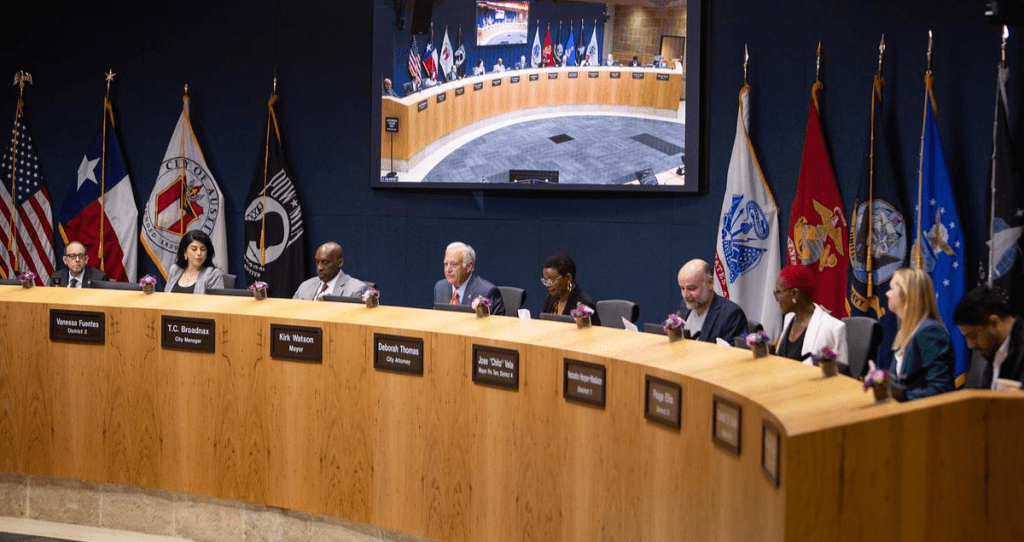
Austin ISD trustees are set to decide Thursday whether to hand over control of three struggling middle schools to an outside operator, a high-stakes vote that could determine whether the district avoids state intervention.
The decision centers on Dobie, Webb and Burnet middle schools, each on the brink of a fifth consecutive failing rating under the state’s accountability system. How trustees vote will shape whether the campuses enter a state-sanctioned partnership or remain under district control as pressure from the state intensifies.
At issue is whether Austin ISD will pursue a partnership under a 2017 state law that allows outside organizations to run campuses in exchange for a temporary reprieve from accountability ratings. All three schools have received four consecutive failing ratings, and another could trigger action by the state education commissioner, including closing campuses or replacing the elected board with a board of managers.
If trustees approve the partnership, the district would submit an application to the Texas Education Agency by March 31, though the state could still deny the application, leaving uncertainty about the schools’ future.
Trustees are weighing a proposal from Texas Council for International Studies, the only publicly discussed partner, though district leaders have disclosed few details about the full pool of applicants.
Austin Current in January requested the names of bidders who responded to the district’s call for potential partners, the written deadline of which was in October, but the district sought a ruling from the Texas Attorney General’s Office on whether the information had to be made public, citing that they were still taking applicants.
State pressure builds on struggling campuses
Current Texas law states if any school receives five failing ratings under the state’s accountability system, the state education commissioner can close the school or appoint a board of managers for the school district, replacing the elected board and diminishing local input.
All three schools have received four consecutive failing ratings, which are largely based on standardized testing scores. Earlier this year, Superintendent Matias Segura presented school-based assessment data to the board for the three schools, which showed significant gains, particularly in seventh and eighth grade math and reading testing at Burnet and Dobie middle schools. However, the improvements fell short of convincing board members the schools could improve the two accountability letter grades needed to avoid state intervention by the end of this school year.
The school district sought partners for the schools under a 2017 law commonly referred to as SB 1882, which allows districts to contract with approved external organizations such as charter schools or nonprofits to run campus operations. Campuses entering a partnership receive a two-year reprieve from state ratings while the external partner works to improve outcomes.
After Mendez Middle School failed to meet state educational standards beginning in the 2014-15 school year, Austin ISD entered a partnership with T-STEM schools in 2018 and then with Third Future Schools in 2022 to operate Mendez and get it to a passing rating.
Earlier this year, Austin ISD leaders announced the current partnership with Third Future at Mendez would end after the charter school partner met its established goal of getting the school to a “B” rating by the 2024-25 school year.
Proposed partnership and community response
During community meetings held at each school earlier this month, district administrators presented teachers and families at Dobie, Webb and Burnet with the potential partnership and what it means for the campuses. Austin ISD administrators said they understand Texas Council for International Studies does not intend to make educators and staff reapply for their positions.
At a March meeting at Dobie Middle School, Austin ISD leaders praised the Texas Council for International Studies work at similar campuses. District administrators said extracurricular and career-readiness programs would continue for students, and the schools would aim to transition to the International Baccalaureate program, an international curriculum that touts practical connections between studies and the real world.
Rodolfo Manzano, whose daughter attends Dobie Middle School, said he supports transitioning the operations of the school if it benefits both the short-term and long-term future of the campus and its students.
“If this is going to represent an improvement for the community, for a more prominent future, if we have to make sacrifices in order to see improvements, well then I do hope it will be for the better,” Manzano said in Spanish.