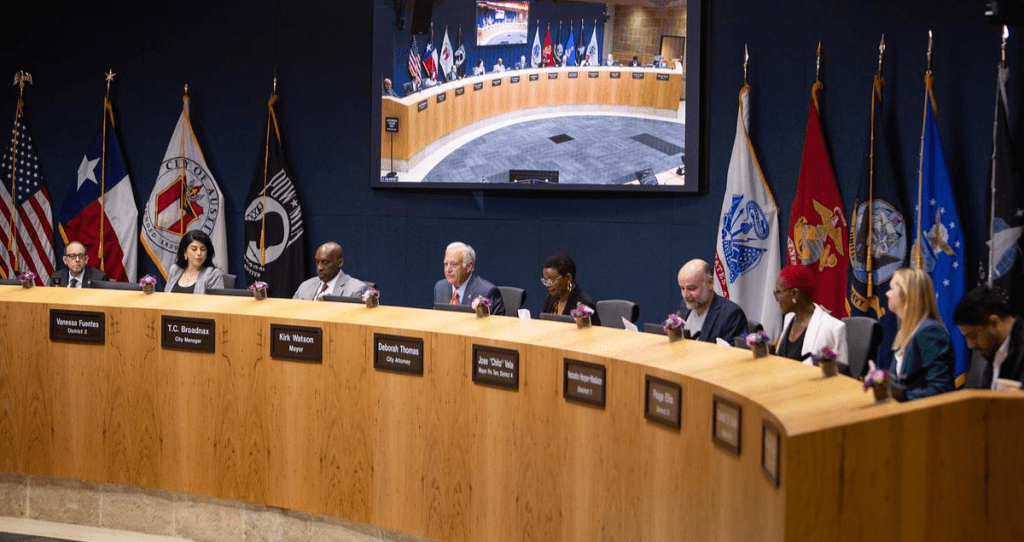
With the threat of a state takeover looming over three Austin ISD middle schools, the district has yet to disclose who is seeking to run them or how many groups have applied. This comes as the district approaches a critical March deadline that could determine whether Austin ISD keeps local control.
The withholding of information comes as district leaders reach the end of their self-imposed timeline this week to discuss and decide on an outside operator for Dobie, Webb and Burnet middle schools, all of which are one failing grade away from triggering state intervention after years of academic failure.
The school board is scheduled to receive an update during Thursday’s board meeting from Superintendent Matias Segura on the so-called 1882 partnerships, a program that allows districts to contract with charter operators or other organizations to run campuses in an effort to avoid closure or state takeover.
Austin ISD has asked the Texas Attorney General whether it can legally keep the identities of the applicants secret. Austin Current requested the records under the Texas Public Information Act after the published deadline on its call for proposals had already passed.
A district may publish a what the Texas Education Agency calls a Call for Quality Schools to invite operating partners to run new or existing schools. In a statement, the agency said districts have discretion over partner selection, and it is up to the district whether to continue accepting bids.
What’s at stake
Dobie, Webb and Burnet middle schools are all one failing grade away from a state takeover under the state’s accountability system. Under state law, if a school receives five failing ratings, the state education commissioner can either close the school or appoint a board of managers for the district to replace the school board, diminishing local input on public education. With the names of potential partners still obscured, time is running out on the chance for public input on the partnerships and the partnerships themselves.
Austin ISD’s current search for a partner follows a rocky history of trying to find outside partners to take over Mendez Middle School, raising questions about how much interest such turnaround work actually draws. In 2018, the district’s first attempt to find an outside operator for Mendez, which had repeatedly failed state accountability standards, received no applicants. After reopening the process, the district drew limited interest with two bidders.
The first partnership failed to produce enough improvement and was later ended. The district in 2022 turned to Third Future Schools. Mendez regained a passing rating after that second partnership and will return to district control this summer after earning a B rating from the state. Until Austin ISD releases the names and number of applicants, it remains unclear whether the district’s latest quest for partners for Dobie, Webb and Burnet drew meaningful competition.
In order to enter a partnership, the school district must submit an application before March 31 identifying a selected partner to TEA. If approved, the partnership would pause state ratings for two years while the outside operator attempts to raise test scores. If the state denies the application or the district fails to select a partner in time, the schools remain at risk of triggering state intervention. Nearly 100 such partnerships exist across Texas.
Austin ISD leaders opened the bidding process for potential partners in September. The district’s own Request for Proposals stated submissions were due by Oct. 21, and proposals received after that date would not be considered “to ensure a fair and transparent solicitation process and the integrity of submissions.”
However, according to a district spokeswoman, the district is still accepting proposals and has yet to select an operator for any of the three schools.
Transparency and competition
Austin Current submitted a request in January for the names of all organizations that responded to the district’s call for partners. On Feb. 9, the district requested a ruling from the Texas Attorney General Office on whether it could withhold that information from public release.
In its filing, the district argued that releasing the names could give competitors or bidders an unfair edge in an active competition, or in a future one the district expects to conduct again.
The district also acknowledged it missed the legal deadline to seek a ruling, which normally means the records must be released. Austin ISD argued, however, that the information should be withheld because “significant privacy interests support the withholding of the information, and those interests are outweighed by the competing interest of disclosure.”
The Texas Attorney General’s Office has up to 45 business days to issue a ruling. Based on the district’s request date, the decision will likely come after Austin ISD’s March 31 deadline to submit partnership applications to TEA, meaning the district could select an operator for the schools without ever publicly identifying who else applied in advance of their decision.
Joshua Jeon, the district’s executive director of governance, accountability and board services, said the RFP is simply a tool the district uses to issue a Call for Quality Schools. Because the district used an RFP format, he said, the district had to list a deadline, even though the partnership process itself does not require traditional procurement. As a result, he said, the district remains open to receiving proposals.
Jeon said the Oct. 21 deadline already reflects an extension for submissions which the district notified potential applicants and updated in the posting. He said no additional extension has been publicly announced, but organizations familiar with the process and aware of the RFP can still submit proposals.
“We gave everyone an opportunity to apply and we extended that deadline so everyone knew we were continuing to receive applications,” Jeon said. “In terms of fair process, we considered every application that came in and if any more were to come in after that deadline we were committed to having the same committee go through the same process to vet it. In that sense, I think the fair process was maintained.”
Jeon said the district extended the window to attract a wider range of applicants and no partner has been formally identified. He said community input will be sought when a potential partner is identified.
Bill Aleshire, owner of AleshireLaw PC and a hotline attorney for the Freedom of Information Foundation of Texas, said the partnership process is relatively new, particularly as a strategy to avoid a state takeover. While districts are not required to use an RFP for a Call for Quality Schools, he said continuing to accept proposals after a stated RFP deadline without announcing an extension or reopening undermines transparency and competition.
“You are not encouraging competition if you keep it secret that you can still submit proposals,” Aleshire said. “They are being excessively sneaky about something that is really important to families and students.”