Less than a year after Austin’s City Council signed off on a plan to build parks over sunken stretches of I-35, city staff are now urging elected leaders to pump the brakes on committing any more public money for the ambitious project.
“At this point, we just can’t recommend you move forward with such a decision, because that does create such a significant risk,” Kim Olivares, the city’s director of financial services, said at a council work session Tuesday.
Olivares said city staff don’t know how much the project will wind up costing and, so far, no private donors have stepped forward to help. Similar projects in Dallas, Seattle and Boston have had at least half their costs paid for by private philanthropic contributions, she said.
Even if the city chooses not to move forward now, the chance to build caps wouldn’t disappear entirely. TxDOT has several windows of opportunity before the I-35 expansion’s estimated completion in 2033. But with each missed opportunity, the cost rises.

Council members skeptical of the plan to fund expensive public parks over the highway took the news as a vindication of their earlier concerns. Those on the council who support concealing a more-than-200-foot-wide highway canyon beneath almost 14-acres of new parks bristled at the gloomy outlook from city staff.
The Texas Department of Transportation has already begun the decade-long project to expand I-35 through Central Austin. The estimated $4.5 billion plan includes sinking the mainlanes up to 60-feet below ground level from Holly Street to Airport Boulevard, allowing decks to be installed over the highway, similar to Klyde Warren Park in Dallas, but almost three times the size.
Last May, the City Council committed $104 million to build the support structures that would make it possible to install decks over I-35 from Cesar Chavez Street to 7th Street and from 11th to 12th street. The funding package included support columns for a pair of 300-foot-wide “stitches” between 41st Street and CapMetro’s Red Line.
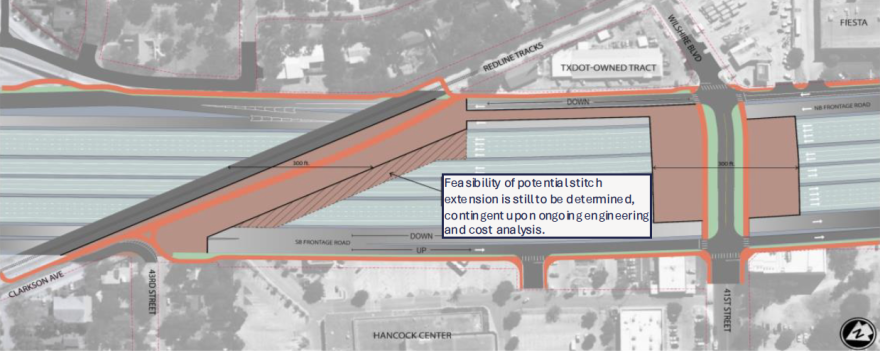
Now, the City Council is facing the first of several deadlines to decide where to build the actual caps. Those barren concrete surfaces, along with the required safety equipment like fire extinguisher systems, are estimated to cost $346 million, a total that would be paid in installments to TxDOT over several years.
Once the barebones caps are installed, the city would still have to come with the funding for anything that goes on top of them such as grass and trees, splash pads, tennis courts, soccer fields or rock climbing walls. The cost of those additional amenities is pegged at $258 million, bringing the total estimated bill to $604 million, not including annual operations and maintenance costs.
City staff said those estimates are still highly uncertain, largely because the designs aren’t complete.
The city has not yet paid TxDOT the $25 million required for a full design of the caps. Without those detailed plans, city officials and council members are left without firm estimates for most of the project.
At the request of the city, TxDOT in January conducted a more refined cost estimate of the cap between 11th and 12th streets. The price tag soared by 62% to $86 million.
But that cost hike was caused by unique factors that wouldn’t apply to other cap locations. Among them: the original design didn’t allow for two story buildings.
“We do not want to conflate the escalation seen here with 11th to 12th as to something that would be seen across the board,” Briana Frey with Austin Transportation and Public Works told council members. “The other cap deck locations will not have the same impact.”
TxDOT spokesperson Bradley Wheelis agreed, telling KUT News that the increase to the cost estimate at the 11th to 12th street cap is “not a good representative of other locations.”

But the uncertainty around costs prompted some council members to question whether the city should reverse course on some of the highway support structures it already agreed to fund.
“I’d like to understand the possibility for staff bringing forward an assessment of options to actually scale back the structural elements,” Council Member Krista Laine said. The sentiment was echoed by council members, including Mike Siegel and Paige Ellis.
The pessimism seemed to frustrate council members who have been eager to add acres of new green space atop a highway that’s separated the city since it opened in 1962, along what was once a city-designated racial segregation boundary.
“This is not about what happens in the next four years or 10 years. This is what happens in the next 100 years,” Council Member Ryan Alter said. “This is about 2050, 2070, what our city is able to put in these spaces for the next generation and the generation after that.”
“We have to have an aggressive capital campaign if this is going to be successful,” Alter said.
City Council is expected to vote by May on whether it will commit to funding additional cap locations. TxDOT said its formal deadline to include the caps in the state agency’s 2028 bid package is November 2026. That date that was originally chosen last May to give the city the option of holding a bond election on the caps.
If City Council follows staff’s recommendation and holds off, more chances to add caps could arise between 2028 and 2032. But those later additions would come with higher price tags.
After the I-35 expansion is complete, currently expected around 2033, a 10-year moratorium on any new I-35 construction would push the next opportunity to build caps to 2043.