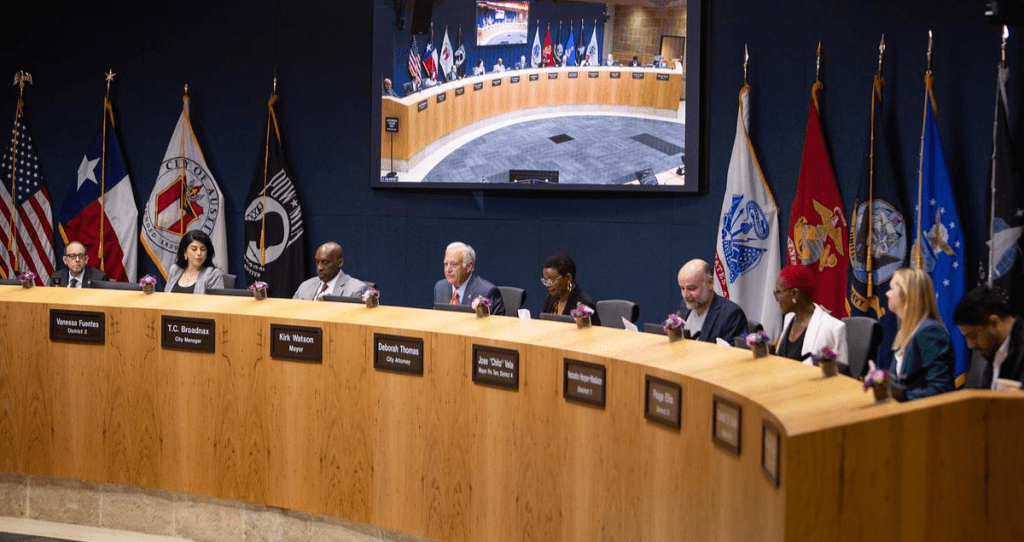
Austin City Council has approved guidelines for how a new natural gas “peaker plant” will be built and operated. Council members say the rules will help reduce emissions and harmful local impacts from the facility, the future location and cost of which remains unknown.
Gas peakers are natural gas power generators that can start up quickly and run when demand for energy is at its peak and electricity costs are highest.
Austin Energy, the city’s electric utility, says the project is necessary to fight high energy costs and guarantee reliability into the future.
But gas generators contribute to climate change and create toxic air emissions. It is that downside that the new guidelines, passed Thursday, aim to address.
“We are going to reduce our emissions, not increase them,” Councilmember Ryan Alter, sponsor of the resolution, said ahead of the vote.
Alter said the city could accomplish that reduction by running the new “cleaner” generation units in place of older, less efficient gas generators.
To do that, the guidelines tell Austin Energy to limit the use of older gas peaker units at Austin’s Decker Creek power plant “to only times of extreme scarcity.”
The measure also creates a cap for annual emissions of CO2 and nitrogen oxide from the city’s fleet of gas power plants. It does that by telling Austin Energy to limit those emissions below the amount city gas plants produced in the year before the new peaker plant starts running.
Austin Energy estimates the new power generators will not be operational until 2030.
That measure also carries an exemption for emissions created during “local reliability events or extreme grid events.”
“It’s all a balancing act,” said Alter, “We want to make sure that we are being responsible stewards of our environment […] but we also have a duty to ensure that people have electricity.”
Effectiveness of proposals depend on implementation
The plan to purchase new gas generators sparked an outcry from city environmental and climate watchdogs.
Those groups, along with open government advocates, excoriated the City Council for approving the purchase of new gas generation by a secret vote in executive session last week.
But some of the same critics offered support for Alter’s measures on Thursday, while warning that the effectiveness of his emissions caps will depend on how Austin Energy chooses to implement them.
Rafael Schwartz is a member of the Austin Sierra Club and serves on the City’s Electric Utility Commission.
Ahead of the vote, he pointed out that the mandate to cap emissions below what they were in the year before the new gas plant starts running, “could be read as incentivizing the utility to run the peaker fleet more than it currently does in the year before the new units are installed.”
If Austin Energy ramps up natural gas power use and emissions during that year, he explained, it would create a higher baseline of allowable emissions into the future.
How much emissions are actually reduced will also depend on how Austin Energy defines the reliability events that will exempt it from council-mandated limits.
In a presentation that Austin Energy released last month, the utility forecast that it could experience 575 “reliability risk hours” annually in the near future if new gas generators are not installed.
If pollution produced during those “risk hours” is exempted from city-mandated emissions limits, it would mean the utility could emit CO2 and nitrogen oxide for about six percent of the year without it counting against the new guidelines.
“Austin Energy is reviewing and evaluating the items passed by City Council today related to the natural gas peaker units,” Austin Energy spokesperson Matt Mitchell said in a written response to questions about how it may define reliability events. “Responses to each of the resolutions will be provided by the deadlines established by City Council.”
The ultimate location for the new gas generators also remains unknown. They could be installed in a new facility or added to one of Austin’s existing gas power plants, like the Sand Hill Energy Center or the Decker Creek Power Station.
Two resolutions also passed Thursday aimed at identifying a location for the new gas generators and mitigating their impact on local communities.
While the purchase of materials for the peaker plant is moving ahead, the debate over where it should be located may be just beginning.
Austin Energy has released a shortlist of 14 potential locations for new energy projects, including gas peakers. At Thursday’s meeting, Monica Guzmán, the policy director for the East Austin community group Go Austin / Vamos Austin, noted that nine are in East Austin.
“We are opposed to gas peakers, they negatively impact health,” said Guzmán. “I wouldn’t want to live anywhere near a gas peaker.