Amid an ongoing budget crunch and a scorching summer that has compelled residents to cool off in city pools or shady public green spaces, Austin park advocates warn that if City Council does not call a bond election, some aging facilities could be at risk of closure.
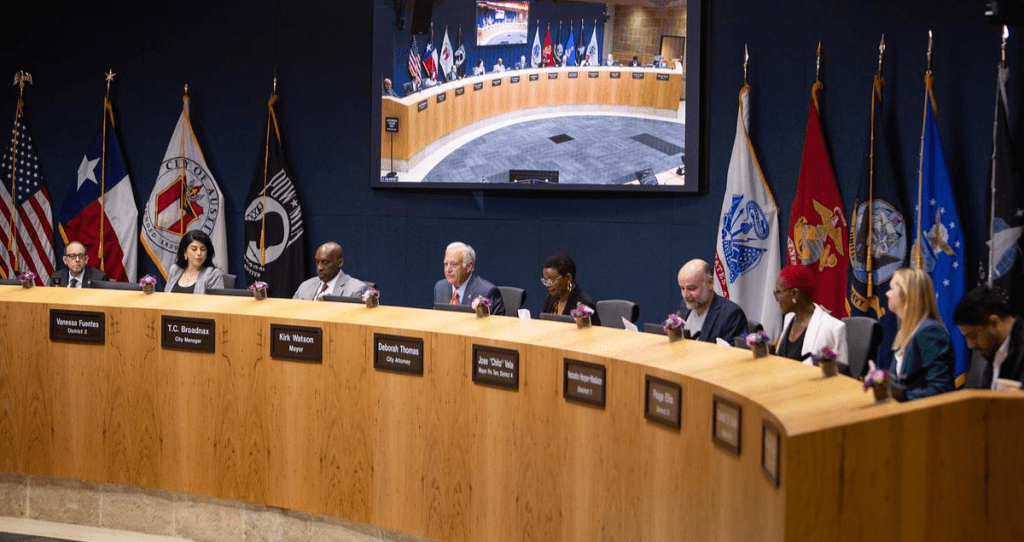
Austin City Council members are scheduled to vote Tuesday on a November bond election, which could total as much as $390 million, finally bringing a two-year planning process to a close. After months of reviewing and refining several bond scenarios developed by a city-appointed bond task force and city financial staff, council members are poised to make a final decision on whether to move forward with an election that could feature multiple bond propositions, including funding for parks and community facilities, such as libraries.
The bond election has become a flashpoint at City Hall. Supporters argue calling an election is critical to address pressing capital needs, including improvements to parks and recreation facilities. Others contend delaying the election until 2028 is necessary to show voters the city is serious about demonstrating fiscal restraint following last fall’s failed tax rate election. The ongoing uncertainty surrounding the election’s size and shape has led park supporters to sound the alarm on the urgent need for funding and the threat to city parks and pools if they don’t receive it.
“Parks can’t wait till 2028,” said Alyssa Vargas, advocacy manager at the Austin Parks Foundation, who said parks currently have $1.8 billion in unmet needs. “It’s pretty critical that we receive what we can now.”
The Austin Parks Foundation is advocating for a $250 million parks bond package, noting the department has not received bond-approved funding since 2018.
“In 2018, we received $149 million in bond, and that went towards some really great projects that we’ve done across the city,” Vargas said. “We fully allocated and expended those dollars in a six-year cycle.”

Pools with dried-up budgets
Of particular concern are aging public pools across the city that are likely to require major improvements in the coming years.
Several pools “are likely to go out of commission unless they get this bond funding,” Vargas said.
One of the pools is South Austin’s Garrison Pool, which is south of Ben White Boulevard near the intersection of West Stassney Lane and Menchaca Road. Park advocates warn it could close if more funding is not secured.
“It would be such a huge loss,” said Katherine Romans, who frequently uses the pool with her children as a respite during Austin’s sweltering summers.
“This is a place where families come to host birthday parties, where neighbors gather, where folks come every day to do lap swimming, and to get a break from the intense heat,” she added. “To lose all of that would really be a gut punch to the community itself.”
As an aging facility that has offered Austinites a break from the heat since the 1960s, what could start as a routine repair could uncover more extensive problems and drive up costs. Without funding for those larger improvements, the pool could eventually be forced to close, Vargas said.
“As Austin experiences more and more hot summers, hotter and longer in terms of heat,” Romans said, “it’s really important for a human health and safety perspective to have places like Garrison Park Pool.”
Ted Siff is the treasurer for Austin Outside, a coalition of nonprofits and businesses advocating for Austin’s parks. He said Garrison Pool is one example of many types of facilities across Austin’s park system with aging infrastructure at risk of shutting down for safety reasons.
Places “that people rely on for their health, mental, physical or both, may not be accessible,” Siff said. “Millions of dollars worth of deferred maintenance money is in the park bond.”
Decisions ahead
City Council started planning for a 2026 bond election in 2024, when it formed a bond advisory task force. While staff at that time identified an estimated need of more than $4 billion, Austin’s financial services department said in early 2026 that any bond election should be limited to $750 million. Since then, City Council members have thrown support behind a smaller option, about half the cost that prioritizes park funding, while other council members have favored delaying a bond election altogether.
In November 2025, voters soundly rejected Proposition Q, the measure that would have raised property taxes to pay for city services. The defeat was widely viewed as a sign of eroding public trust in how City Hall manages taxpayer dollars. In one effort to build trust back, Austin Mayor Kirk Watson pushed forward a “decision tree” to help determine whether calling a bond election would be financially prudent.
Using that framework, city financial staff determined previous bond programs had not yet reached what they consider program completion, defined as spending about 90% of bond funds. Based on that criterion, they recommended the election take place in two years. Watson agreed.
Leadership “means being willing to say ‘not yet,’ especially when saying ‘yes’ would be politically easier in the moment,” Watson said in May.
As an alternative to a bond election, the city released a “bridge” scenario that could fund some pressing critical infrastructure projects between now and 2028, when a larger bond election could be called and the majority of previous bond funding is expected to be spent.
In a July 21 memo, Assistant City Manager Mike Rogers outlined that the interim package would allocate $77 million for parks, $41 million for watershed protection and $32 million for transportation and public works.
Ahead of Tuesday’s meeting, Council members Mike Siegel and Chito Vela asked staff to prepare two bond proposals — a parks bond and a community facilities bond, which would support the Hampton Branch Library. There’s also a chance council members could approve bonds to be voted on for transportation, a homeless resource center and Austin Animal Services.
Monitoring how these city debates play out is a “hobby” of his, Siff said. “Rather than football or something like that, I’m interested in the city’s capital budget.”
Since watching his first bond election in the 1990s, Siff said the current bond cycle has sparked the most robust discussion he has seen.
“This is a very dynamic situation,” Siff said.