With the possibility of a transit strike shutting down virtually all fixed-route bus service in Austin, a CapMetro board member joined transit workers Monday in calling on the agency to push harder for a labor agreement.
Meanwhile, an executive with Keolis, the private contractor which operates most of CapMetro’s bus service, acknowledged to KUT News that the company must negotiate within financial limits set by the transit agency.

Council Member Zo Qadri, who also serves on the CapMetro board, told reporters that he’s asked tough questions of the agency’s leadership as about 1,400 bus drivers, mechanics and other workers threaten their first strike since 2008.
Asked whether CapMetro controls how much workers can be paid, Qadri said “it seems like CapMetro could put their thumb on it … a little bit firmer.”
The comments increase scrutiny on a central question in the dispute: How much control does CapMetro have over negotiations it has publicly characterized as being a matter between Keolis and Amalgamated Transit Union Local 1091?
Keolis Assistant General Manager Cynthia Rasco said the company decides how to bargain within the constraints of money available. And she confirmed the limits are set by CapMetro.
“Not that they tell us how to do that, but there’s a certain financial parameter that we do have to remain within,” Rasco said.
A July memo to CapMetro’s board uses similar language, saying Keolis is negotiating “within the financial parameters provided by CapMetro.” The memo says Keolis may have to find savings elsewhere in the union agreement.
Workers who spoke before the CapMetro board at its meeting Monday said their demands reflect Austin’s cost of living and the risks they face at work.
“We need more money. We are beaten, jumped on, spat on, but we’re called essential workers. And those same people can ride the next day,” said Tawauna Andrew, who described herself as a bus driver and former train operator. “Spit on a police officer, see what happens. Spit on an ambulance driver, see what happens.”
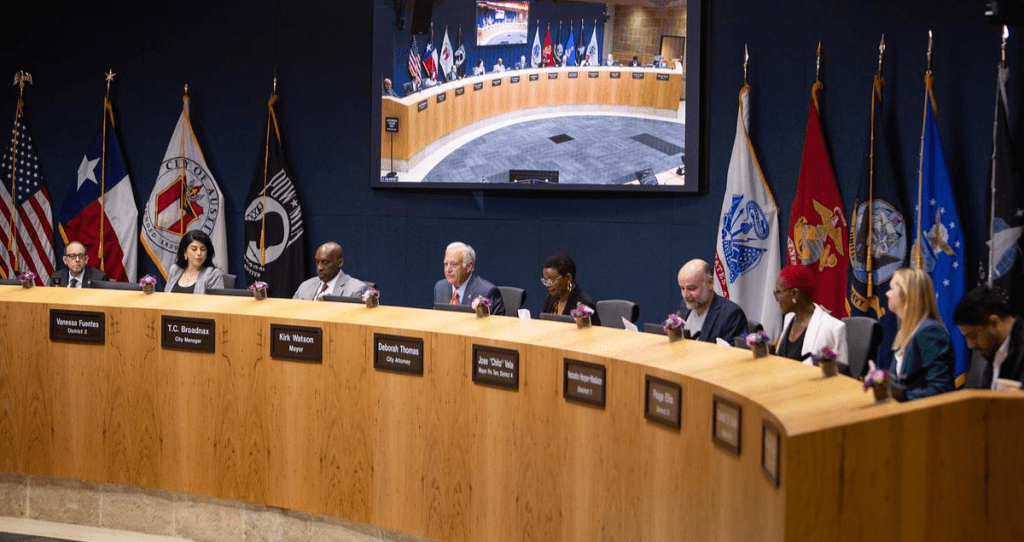
The board heard about two hours of public testimony, most of it in support of workers. Several board members later expressed support for Keolis employees, although the board took no formal action in negotiations.

The July memo also provides CapMetro’s most detailed public account so far of wage negotiations. The ATU has said it’s seeking pay increase of 14% over three years.
Keolis has proposed annual age increases of 3%, 4% and 5% over three years, adding up to 12%. The first raise would be retroactive to Jan. 1.
The company has also offered a $1,000 ratification bonus, paid in two installments. In exchange, workers would agree to a stricter attendance policy.
A second option would provide a $2,000 bonus but reduce the third-year raise from 5% to 4.5%.
Keolis describes the second option as a 14.8% compensation package, exceeding the union’s request for raises totaling 14%. But that Keolis calculation includes both one-time bonuses. Under that option, the permanent wage increases would total 11.5% over three years.
The company said those bonuses would give workers more money up front. Union leaders say one-time payments are less valuable than raises that permanently increase hourly wages.
Both sides are also drawing a distinction over training, which workers have identified as one of the concerns behind their strike vote. Union members voted 99.5% in late June to authorize a walkout.
The CapMetro memo responds to a July 13 KUT News story in which union officials said more training for operators and mechanics could improve bus service. Neither CapMetro nor Keolis agreed to an interview for that story, and neither answered KUT’s specific written questions about operator training, maintenance training or bus availability.
In a letter attached to the memo, Keolis General Manager Duane Eskierka wrote that training requirements and compensation for mechanics are negotiated under the labor agreement, but bus driver training is not covered under the current contract.
“Operator Training is not subject to collective bargaining,” Eskierka wrote. He said Keolis and the union instead discuss the operator-training program through “several collaborative forums.”
ATU Local 1091 President Brent Payne said that distinction describes the current agreement, but not everything the union is seeking in the next one.
After drivers attend an initial CapMetro training academy, Payne said, Keolis offers an additional three weeks of training behind the wheel to learn routes.
“That’s not enough time,” Payne said. “When I started here, I did eight weeks of route training.”
Payne said some drivers have begun regular service without knowing routes well enough, leading them to miss turns or end up far away from where they’re supposed to be. The union wants the amount of route training to become an enforceable part of the labor agreement rather than remain solely a management decision.
CapMetro has said it reviewed wages at other transit agencies and analyzed its own operating budget, which is mostly fueled with sales tax revenue. The agency has said it can’t provide more money for the labor agreement without reducing transit service.
Keolis says it’s bargaining in good faith. The company says its operator wages and health benefits are competitive with those offered by other large Texas transit systems.
“This is Austin. We want to make sure that our operators are able to continue to maintain their households through coming to work every day,” Rasco said.
Standing in front of union members and addressing reporters on Monday, Payne said negotiations had stalled and no future meetings were planned.
“A strike or work stoppage is not what we want,” Payne said. “Just what we may have to do.”