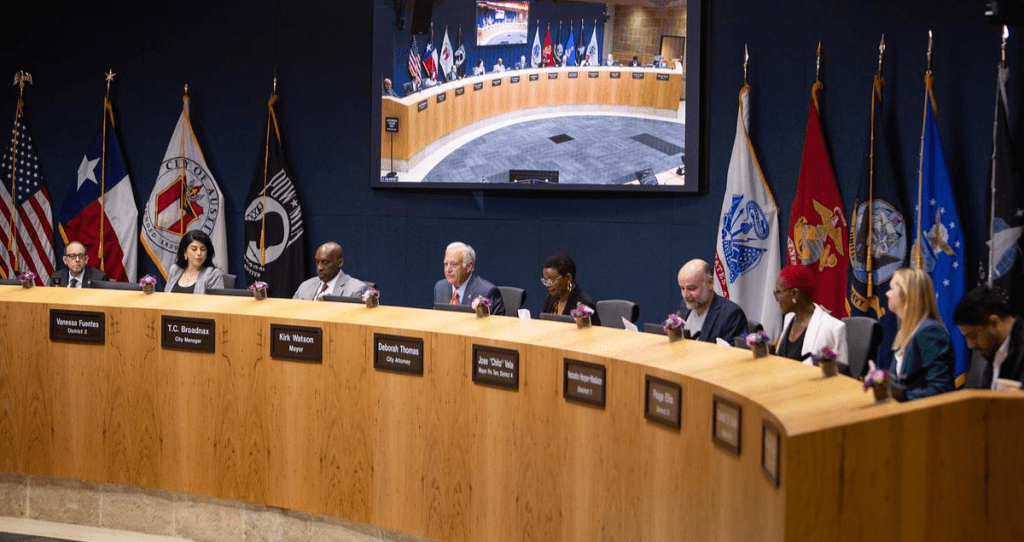
When the Austin City Council approved Austin Energy’s plan to buy new natural gas “peaker” units last week, council members voted behind closed doors, an unusual move that sparked backlash from environmental advocates and government watchdogs who accused city leaders of shielding a controversial public decision from scrutiny.
Because the city operates Austin Energy, state law allows City Council to privately discuss, vote and take final actions on “competitive matters” as the utility’s governing body. Mayor Kirk Watson said the city not only had legal authority to do so, but also a fiscal responsibility to protect Austin Energy’s negotiating position. But the criticism, particularly among those opposed to the natural gas-powered units, was swift.
“We’re struggling to understand why wind, solar and battery contracts can be deliberated and voted on in public and a gas peaker contract has to be voted on in secret,” said Kaiba White, a climate and energy policy analyst for Public Citizen. “We’re very disappointed in the manner in which they went around being transparent.”
On Thursday, the Austin City Council approved three new energy-generating projects intended to help the municipally operated utility reduce the risk of blackouts and price spikes. Two of the measures drew broad support, but the proposal for the new gas peaker units prompted sharp public opposition. Unlike the two other energy proposals, which were approved publicly, the Austin City Council voted on the peaker proposal in executive session.
White, who also serves on the city’s Electric Utility Commission, said much of the public input on this topic has been negative. “Then the council decides to move forward anyway, and they do it in a way that has no transparency and that limits any sort of accountability,” she said.
Why the vote happened in private
During the City Council work session earlier in the week, ahead of Thursday’s vote, Watson cited the Texas Open Meetings Act when explaining why the decision would take place in executive session. State law does not require a “public power utility governing body” — in this case, the Austin City Council — to “conduct an open meeting to deliberate, vote, or take final action on any competitive matter.”
Watson said public discussion surrounding the costs of the units could weaken the city’s negotiation position. Austin Energy also said it is a “seller’s market” for the peaker units and argued that because it had not yet entered formal negotiations, it was necessary to have those conversations in private rather than in a public forum.
“There is a good, good reason for us to be making certain decisions where we’re not showing our hand,” Watson said.
Executive sessions are typically used for deliberations on sensitive matters, such as legal issues, real estate negotiations or personnel issues. While council members routinely deliberate privately on such issues, votes are usually held in public and are recorded publicly.
Debate centers on public process
Peaker units are power generators designed to come online quickly during periods of high electricity demand, such as heat waves or winter storms. Austin Energy has said the units are critical during those surges.
The utility has emphasized the new peaker units would come with safeguards and would be more efficient than Austin Energy’s 10 older peaker units currently in operation. They would also have runtime limits and use technology designed to reduce harmful air pollution by 80% to 95% compared to the city’s older peaker units.
Despite making the final decision in private, the City Council pulled the agenda item related to the acquisition of peaker units from the consent agenda to allow for public discussion before the vote. While a good portion of the discussion was in opposition to the item, several speakers expressed support for bolstering grid reliability.
“These peaker units are not about abandoning climate goals,” said Jeremy Hendricks, speaking as a representative of the Laborers’ International of North America, a union representing construction workers. “They are an insurance policy for extreme heat, severe winter weather, grid emergencies and the growing energy demands facing our city.”
Longtime Austin environmental activist Paul Robbins said he was more troubled by the vote behind closed doors and the potential cost of the project than by the proposal of peaker units itself.
The utility previously told Austin Current the resources cost about $2,500 per kilowatt, or about $2.5 million per megawatt. Since Austin Energy is seeking enough units to generate 400 megawatts of power, the project could cost roughly $1 billion. The final contract has not yet been made public.
Robbins said he believes City Council should have slowed down and waited until the price of the technology potentially declined.
“I emphatically think that the council should disclose what they voted on, approximately how much this will cost, why they’re not waiting to get a better price when the costs come down, and how they voted,” said Robbins, who has been locally active since the late 1970s.
“Without exaggeration, I have never seen a City Council do anything like this,” he added. “I have never seen an item this non-transparent.”