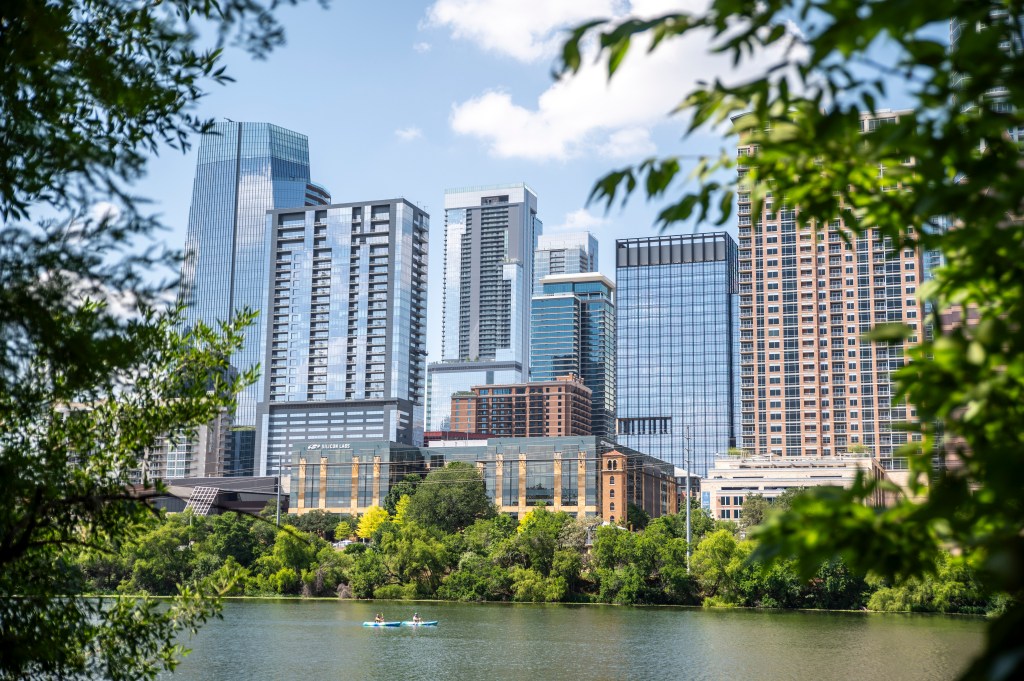
The recent surge in water- and energy-intensive artificial intelligence data center construction has forced lawmakers across the country to find ways to protect limited local resources. Now Austin is too.
As AI use has skyrocketed, so has the need for data centers to house the servers that power it. The facilities can be expansive — some spanning more than 1,000 acres — and resource-intensive, consuming hundreds of millions of gallons of water a year and requiring more than 100 megawatts of power. The city said 1 megawatt is enough to power about 250 homes.
Communities across the country have struggled to develop policies surrounding data centers at the same pace they have been proposed and built. The same is true for Austin, where the city lacks a specific land use classification for traditional and AI data centers, leaving city leaders with limited regulatory authority. Some Austin City Council members are now racing to get ahead of the issue before a hyper-scale facility is proposed within city limits, seeking to tap into the city’s strained water and energy resources.
“I don’t want any data center to come here without receiving approval and without showing that they’re not going to be sucking us dry from a water perspective, using our electricity when others need it,” said Council Member Ryan Alter, one of five council members pursuing new policies and regulations surrounding large-load data centers.
“It’s my hope that we’ll then have a zoning tool where anybody who wants to come here with a data center would have to receive permission to do so.”
New regulations over power
While there are no large-scale AI data centers in Austin, the City Council is scheduled to debate and vote on a resolution Thursday aimed at creating new regulations ahead of one arriving.
The state currently defines a large-load user, data center or otherwise, as a customer requiring 75 megawatts or more. Austin Energy currently supplies power to 10 data centers, which require between 1 and 20 megawatts.
Austin planning staff has proposed the city further define high-impact data centers and create a review process that could require developers to seek additional city approval. Staff is also recommending new requirements for water use, noise, heat and lighting, while emphasizing in Austin’s economic development policy the city will not incentivize data center construction.
“These hyperscalers are at a scale that we have not seen before,” Alter said. “It would be a very high bar for me to approve a local data center that wants to be here … I want these rules to be in place so that we have that authority to say ‘no.’”
Alter said another challenge has been a widespread reluctance by companies to share complete information about resource use. He pointed to a recent state-administered survey that asked operators to provide information about water use, water sources, electricity requirements and cooling systems. Only a small fraction of Texas data center operators responded, according to Texas Tribune reporting.
If the resolution passes, Alter hopes the city will “have a real understanding of what their local impact is going to be,” he said. “We can’t rely on the state to put the rules in place for data centers; we need to do it ourselves.”
Until the city decides on new regulations, Council Member Vanessa Fuentes said she would support a moratorium on data center construction.
“It’s clear that data centers present real risks to our people, environment, and local resources,” she wrote in a recent message board post.
Could more regulation hinder progress?
Navid Saleh, an environmental engineering professor at the University of Texas at Austin, agreed complete transparency has been a challenge with some AI data centers, making it difficult to understand just how much water and other resources the facilities require.
He said there needs to be greater clarity in order to develop more sustainable solutions, something he and other researchers around the world are working on.
Saleh acknowledged the impact data centers can have on communities and the worry they cause, “but on the other hand,” he said, “we also should recognize that it is really not practical for us — financially, economically — to stop AI data centers from coming to Texas.”
Saleh believes it is possible for policymakers and scientists to develop solutions in the coming years to make facilities more sustainable. He cautioned political leaders against blocking data center development altogether while researchers work toward more sustainable solutions.
Saleh said researchers are actively working on new technologies that could cool equipment and reduce the amount of water required to run a data center.
“I think our objective should be not to choose between AI or water or AI or resource,” he said, “I believe we can make this work.”
A new neighbor nobody wanted
While advances might make data centers more sustainable in the future, demand for water and electricity is only one of many concerns driving opposition in communities where hyperscale data centers have been proposed or built.
Abigail Lindsay and her family have lived in a rural part of Hays County since the 1990s. The verdant hills, dark skies, quiet and proximity to San Marcos are among the reasons they’ve stayed. A data center spanning dozens of acres, about 75 feet from their property, was not.
“We first heard about it in February of 2025,” Lindsay said. She hasn’t stopped fighting the proposal since then.
“I’ve gone to a lot of planning and zoning meetings, city council meetings, county commissioners’ meetings, town hall meetings,” Lindsay said. “I’ve talked to every neighbor within a 10-mile radius.”
Beyond the resource demands, Lindsay said she worries about losing the dark skies to the facility’s illumination, the constant hum often associated with data centers, the additional heat they generate and potential air pollution, among other things.
“Property values will plummet, so we will be stuck,” she said. “There’s no way anyone’s going to buy our properties.”
Since initially learning of one data center in early 2025, Lindsay discovered plans for several others in the area. Other residents also took notice, prompting significant pushback that culminated in San Marcos recently banning hyperscale data centers in all zoning districts. Some developers near her property have since abandoned plans; others continue to push forward.
“There should have been federal (regulations), there should have been ones for the state, and there should have been for local,” she said. “The system that was set up to protect individuals and residents — it’s failed us,” she said. “It is the Wild West out here.”