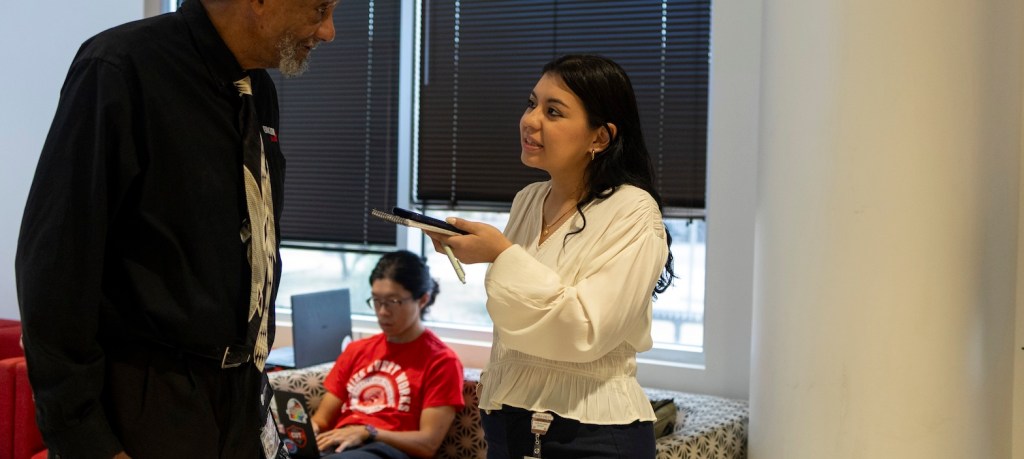
For generations, Sir Swante Palm Neighborhood Park has been a gathering place for Mexican American families in East Austin. Now, as the city and Waterloo Greenway Conservancy prepare to revamp it, some residents say a plan to give naming rights to donors threatens to rewrite that history.
As the design process continues for the 1.8-acre park south of Third Street downtown, Waterloo Greenway Conservancy says it wants to name 10 features after donors. Those could include playgrounds, a misting field and artist benches.
Three other features will be named after community members: a shade pavilion, the stone shelter house and a set of stairs.
But community members say naming parts of the park after people who previously had nothing to do with it erases the Mexican American community’s deep history with the land. Instead, they believe, those spaces should be named after families who used and advocated for Palm Park since its 1933 creation.
“There’s a sadness that once we’re all gone, we’ll be gone forever,” said Marcos de Leon, a community advocate. “We’re erased. It’s shameful.”
The dispute is the latest flashpoint involving Palm Park, where tensions have simmered for years. Community members and the city have already clashed over the 2023 demolition of a long-closed pool and what many see as decades of neglect.
Who gets honored
Palm Park’s upgrade is part of a joint project between the City of Austin and Waterloo Greenway Conservancy, a nonprofit, to develop 1.5 acres of urban parks along Waller Creek. The broader effort is expected to cost $250 million. The conservancy has committed to raising $100 million of that and has raised about $80 million, John Rigdon, Waterloo’s chief planning and design officer said.
In June, the group celebrated the grand opening of “The Confluence,” a 13-acre stretch of green space, a trail and gathering areas stretching from Fourth Street to Lady Bird Lake.
Naming park features after donors is an important tool in fundraising, Rigdon said. It is also guaranteed in the joint development agreement between the nonprofit and the city.
The history of the area will be preserved through signage and community-driven art pieces, including murals and photographs, he said.
Sir Swante Palm Neighborhood Park is named for a prominent Swedish businessman and civic leader. It served as a playground for Palm School, an Austin elementary school that served primarily Mexican American students before it closed in 1976.
While Palm School children played there, beyond the school hours, the park became a community anchor, where families gathered. Over the decades, the largely Mexican American neighborhood advocated for upgrades to the park and to keep the pool open, but it was closed in the early 2000s.
De Leon said he grew up playing in the park and swimming in the pool. He said he has emphasized to Waterloo numerous times over the years that the features should be named after people who have kept the park alive. That’s especially important now, he said, as rising land costs have pushed so many longtime East Austin families out of the neighborhood.
“To me, it’s a slap in the face to the people of East Austin who have been gentrified out,” de Leon said.
Rigdon said Waterloo spent a year talking to about 2,000 community members about the project.
“We work really, really hard to partner with the community and hear everyone’s concerns and develop a community-driven vision for this,” Rigdon said. “It doesn’t always mean we’re going to get it perfect and right, but we want to continue to hear from the community because this is their park.”
Improvements to the Palm Park, which is about 60% designed, will cost $14 million to $15 million, he said. Construction is expected to begin in the middle of 2027 and the park would reopen in 2029.
The frustration over the naming rights comes at a time when people are upset about park disruptions being caused by the I-35 expansion, said Ted Eubanks, a member of the city’s Parks and Recreation Board. The city is expected to shutter part of Palm Park for up to 700 days while waterlines are rerouted into that land to make room for the highway expansion.
“It’s so hard for people to understand the symbolism of sites like that and why people are so emotionally connected to that place,” he said. “And you can say, ‘We’ll do no damage’ but what does that mean?”
Naming rights wouldn’t be an issue if the city put more money into East Austin parks, said Paul Saldaña, a member of the Save Palm School and Palm Park coalition.
“The fact is Mexican Americans contributed significantly to the birth of Austin,” he said. “But here we are, having to pimp out our parks so we can redevelop it. It speaks to the modern day and ongoing lack of acknowledging the contributions of minorities in Austin.”