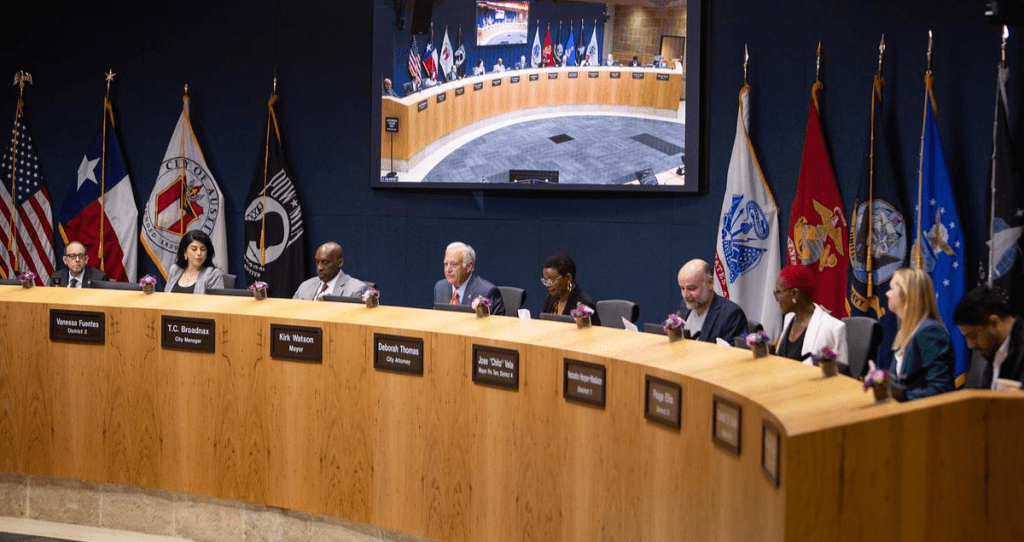
Cranes are already a defining feature of Austin’s downtown skyline, but Austin City Council members on Thursday approved sweeping new development rules aimed at sparking more housing construction and making it easier for developers to build taller projects.
While Austin’s housing market has cooled from the sharp price spikes seen during the COVID-19 pandemic, city leaders and housing advocates say affordability remains a top concern as the region’s population continues to climb. Over the years, the city has adopted strategies to encourage more housing construction, including density bonus programs, a zoning tool that allows developers to build larger, taller projects than normally permitted in exchange for “community benefits,” such as affordable units, sidewalks or green space. But the programs have faced ongoing criticism from both housing advocates and neighborhood groups, who argue the rules either do too little to encourage construction or allow projects that don’t deliver enough affordable housing in return.
The overhaul creates a more manageable, citywide version of the density bonus program that city leaders say will be more effective at producing more housing and affordable units. It replaces Austin’s short-lived, controversial DB90 density bonus program, which gave developers a 90-foot height bonus in exchange for adding affordable housing, but led to taller buildings than some neighbors wanted and less affordable housing production than some hoped for. Still, some housing advocates remain wary that the new one will be successful in helping developers break ground, while opponents worry the new rules go too far.
“Two steps forward, one step back,” said Greg Anderson, a longtime Austin housing advocate. “What was sad about last night is that we lost real potential for better zoning categories.”
Too far or not far enough?
The approval followed a year-long review and revision process. Under the new rules, developers will be able to seek an additional 15, 30, 45 or 60 feet of height depending on zoning rules, the type of housing in a neighborhood and how close the site is to those houses.
“This new tool has a range of options,” Council Member Ryan Alter told the Current. The 15-foot intervals better meet the scale and needs of the neighborhood, resulting “in much better outcomes for everybody.”
The added flexibility could help more housing projects move forward. In exchange, developers using the program would have to provide on-site affordable housing or other community benefits, such as wider sidewalks or trees. Some developers will retain the option of paying into Austin’s Housing Trust Fund, which funds affordable housing projects, as a community benefit.
Anderson’s frustration is with council’s addition of compatibility restrictions, such as how tall a building can be next to a single-family home, and its rejection of larger height allowances desired by some housing advocates. He criticized the city for continuing to require developers to go through Austin’s lengthy rezoning process, which he argued could continue slowing housing construction.
“We don’t have the zoning tools in the toolbox that we need,” Anderson said. “Until the majority of Austinites can feel that they can own their own home again, we are not finished when it comes to land-use reform.”
And while Anderson said the city did not go far enough, opponents such as District 10 Council Member Marc Duchen argued the changes give developers too much flexibility without guaranteeing more affordable housing. Duchen was the sole council member to vote against the proposal, warning the policy could lead to large apartment buildings in neighborhoods where residents do not want them.
“Not everybody wants to live in mixed-use apartments jammed up against their neighbors,” Duchen said. “The appeal of the city for many is the open space, the clear sky, the quiet leisure of private life.”